Understanding Kotlin Coroutines Flow Internals: Flow Builder, emit, and collect
Japanese version: This article is also available in Japanese on Zenn.
Kotlin Coroutines Flow is now widely used in both Android app development and server-side Kotlin. Yet, many developers use it without fully understanding how it works internally.
In this article, we will decode the internal implementation of Flow from its source code. The primary audience is intermediate developers who know the basic specs of Flow and use it in production, but treat it as a black box. The goal is to help readers build a mental model of what happens under the hood, enabling them to implement, debug, and review Flow-based code more effectively and with greater confidence.
For an overview of Kotlin Coroutines internals, please refer to my talk at Kotlin Fest 2025.
Note: The version of
kotlinx.coroutines1 used in this article is v1.10.2, the latest version at the time of writing.
Looking at the Flow Sample Code
The first sample code that appears in the official Kotlin documentation for Flow2 looks like this:
fun simple(): Flow<Int> = flow { // flow builder
    println("Flow started")
    for (i in 1..3) {
        delay(100) // pretend we are doing something useful here
        emit(i) // emit next value
    }
}

fun main() = runBlocking<Unit> {
    // Launch a concurrent coroutine to check if the main thread is blocked
    launch {
        for (k in 1..3) {
            println("I'm not blocked $k")
            delay(100)
        }
    }
    // Collect the flow
    println("Calling collect...")
    simple().collect { value -> println(value) }
}Running this code produces the following output.
Calling collect...
Flow started
I'm not blocked 1
1
I'm not blocked 2
2
I'm not blocked 3
3
We can see that values are emitted every 100ms, and the execution thread is not blocked.
Also, notice that “Flow started” is printed after “Calling collect…”, which tells us that the processing inside flow only begins after collect is called. A Flow that does not start processing until a Terminal Operator such as collect is called is known as a Cold Flow.
This behavior is fundamental knowledge that most Kotlin engineers are familiar with.
But can you explain why this behavior occurs under the hood?
In the following sections, we will decode the internal implementation of three key functions — flow, emit, and collect — to reveal the mechanism behind it.
Internal Implementation of the Flow Builder (flow function)
Functions used to create a Flow are called Flow Builders. The flow {} seen in the sample code above is one type of Flow Builder.
Here is the implementation of the flow function:
public fun <T> flow(@BuilderInference block: suspend FlowCollector<T>.() -> Unit): Flow<T> = SafeFlow(block)The flow function itself is simple: it takes a block argument and uses it to create and return an instance of the SafeFlow class (we’ll cover SafeFlow shortly).
What’s worth focusing on is the signature of the block parameter: @BuilderInference block: suspend FlowCollector<T>.() -> Unit.
The suspend FlowCollector<T>.() -> Unit part:
Kotlin has a concept called Function Type with Receiver3, written as Receiver.(T1) -> ReturnValue. Inside such a lambda, the receiver object is accessible as this. Here’s a simple example:
data class User(val name: String)

// A function type with receiver where User is the receiver — the User object becomes `this`.
val greet: User.(Int) -> String = { times -> "${this.name}, ${"Hello!".repeat(times)}" }

fun main() {
    println(User("Kotlin").greet(3)) // Kotlin, Hello!Hello!Hello!
}Back to the flow function: block is a lambda of type suspend FlowCollector<T>.() -> Unit — a suspend function with FlowCollector<T> as its receiver. Because block is a suspend function, it can call other suspend functions such as emit and delay inside it.
The @BuilderInference part:
Warning: As of Kotlin 2.0,
@BuilderInferenceis deprecated. Builder type inference is now enabled automatically.
@BuilderInference is an annotation that enables a compiler feature called builder type inference4.
A builder function is a function that accepts a lambda with a receiver and assembles an object to return.
Here’s an example. buildBox is a builder function that creates a Box<T>, accepting Box<T>.() -> Unit as its lambda. Builder type inference means inferring the type parameter (T) of the builder function from the function calls inside the lambda. In the example below, T is inferred as String from add("hello") inside the lambda.
import kotlin.experimental.ExperimentalTypeInference

class Box<T> {
    val items = mutableListOf<T>()
    fun add(item: T) { items.add(item) }
}

// NOTE: Before Kotlin 2.0, @BuilderInference was required to infer T.
@OptIn(ExperimentalTypeInference::class)
fun <T> buildBox(@BuilderInference block: Box<T>.() -> Unit): Box<T> = Box<T>().apply(block)

fun main() {
    val stringBox = buildBox {
        add("hello") // T inferred as String from add("hello")
        add("world")
    }
    println(stringBox.items) // [hello, world]
    val intBox = buildBox {
        add(1) // T inferred as Int from add(1)
        add(2)
    }
    println(intBox.items) // [1, 2]
}Back to the flow function: thanks to builder type inference, the type T in Flow<T> is inferred from the type of the value passed to emit inside flow {}.
val f = flow {
    emit(42) // T inferred as Int → f: Flow<Int>
}
To summarize so far: the flow function is a builder function for Flow<T>, and it uses a function type with receiver — suspend FlowCollector<T>.() -> Unit — to assemble the Flow<T>.
Next, let’s look at what FlowCollector is.
Internal Implementation of FlowCollector
Here is the implementation of FlowCollector:
public fun interface FlowCollector<in T> {
    /**
     * Collects the value emitted by the upstream.
     * This method is not thread-safe and should not be invoked concurrently.
     */
    public suspend fun emit(value: T)
}FlowCollector is a Functional Interface (also known as a Single Abstract Method (SAM) interface)5.
A functional interface contains exactly one abstract method and is declared using fun interface.
One key characteristic of functional interfaces is that they can be instantiated concisely using a lambda, through a mechanism called SAM conversion.
As shown below, when passing a FlowCollector<T>, you can simply pass a lambda — it will be treated as the implementation of the emit function.
fun <T>f(collector: FlowCollector<T>) {}

fun main() {
    // Explicit definition
    f(object: FlowCollector<Int> {
        override suspend fun emit(value: Int) {
            println(value)
        }
    })
    // Using SAM conversion
    f { value: Int -> println(value) } // the lambda is treated as the emit implementation
}
To understand what FlowCollector is for, we need to look at Flow itself.
Flow is an interface with only one function: collect.
public interface Flow<out T> {
    public suspend fun collect(collector: FlowCollector<T>)
}The collect function takes a FlowCollector as its argument.
This means that passing a lambda to collect is equivalent to explicitly constructing a FlowCollector, as shown below:
import kotlinx.coroutines.*
import kotlinx.coroutines.flow.*

fun simple(): Flow<Int> = flow {
    for (i in 1..3) {
        delay(100)
        emit(i)
    }
}

fun main() = runBlocking<Unit> {
    // Equivalent to: simple().collect { value -> println(value) }
    simple().collect(object: FlowCollector<Int> {
        override suspend fun emit(value: Int) {
            println(value)
        }
    })
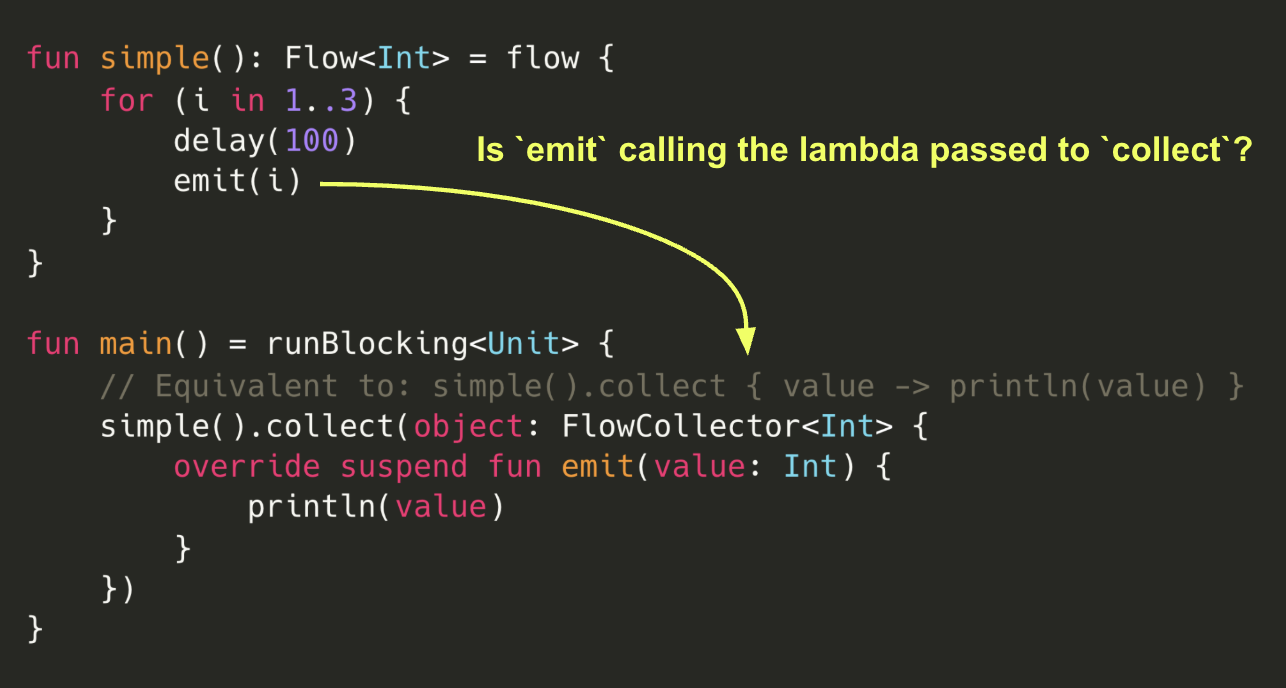
}At this point, a hypothesis may come to mind:
Could emit called inside the Flow Builder (flow function) actually be calling the lambda passed to collect (i.e., FlowCollector’s emit)?
To verify this, let’s finally look at the SafeFlow implementation we set aside earlier.
Revisiting the Internal Implementation of flow
As a reminder, the flow function takes a block argument and returns an instance of SafeFlow.
public fun <T> flow(@BuilderInference block: suspend FlowCollector<T>.() -> Unit): Flow<T> = SafeFlow(block)Looking at the SafeFlow implementation, we find a collectSafely function.
In collectSafely, a FlowCollector is received, and block (the lambda with FlowCollector as its receiver) is invoked.
private class SafeFlow<T>(private val block: suspend FlowCollector<T>.() -> Unit) : AbstractFlow<T>() {
    override suspend fun collectSafely(collector: FlowCollector<T>) {
        collector.block()
    }
}SafeFlow<T> extends AbstractFlow<T>. Here is the source of AbstractFlow:
public abstract class AbstractFlow<T> : Flow<T>, CancellableFlow<T> {
    public final override suspend fun collect(collector: FlowCollector<T>) {
        val safeCollector = SafeCollector(collector, coroutineContext)
        try {
            collectSafely(safeCollector)
        } finally {
            safeCollector.releaseIntercepted()
        }
    }

    public abstract suspend fun collectSafely(collector: FlowCollector<T>)
}Inside AbstractFlow’s collect, collectSafely is called.
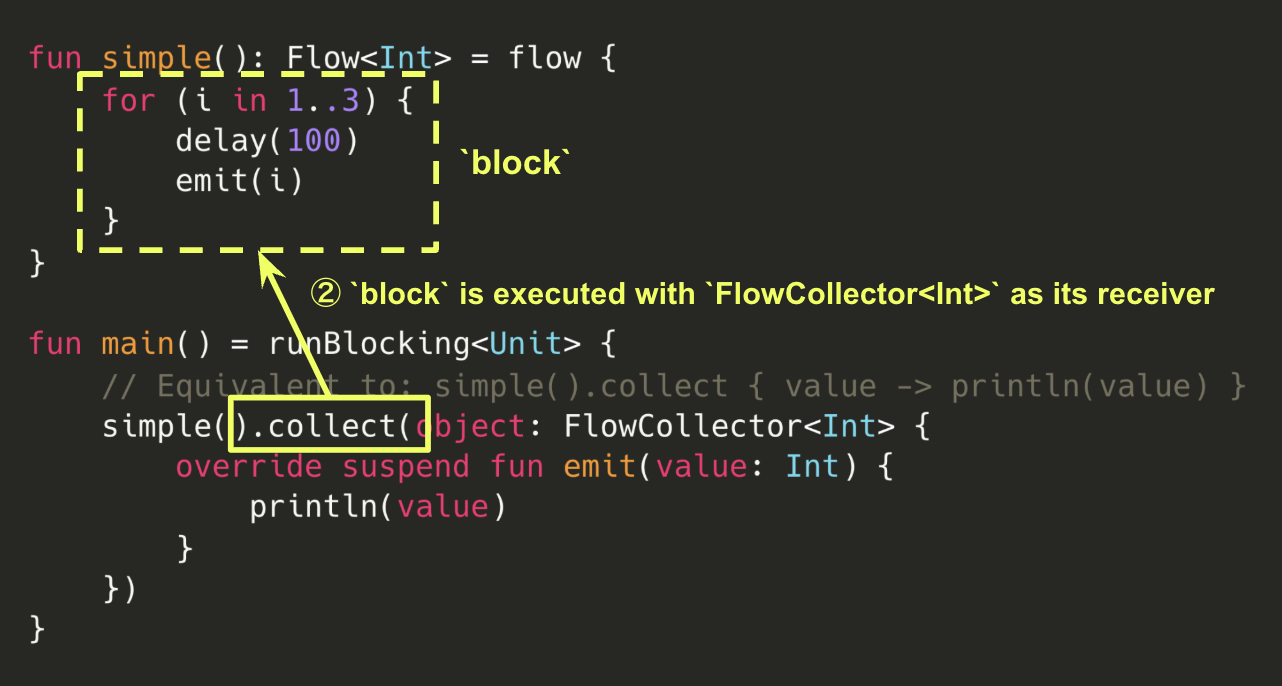
In other words, when collect is called on a SafeFlow, collectSafely is called, and block (the lambda passed to flow) is executed with the FlowCollector passed to collect as its receiver.
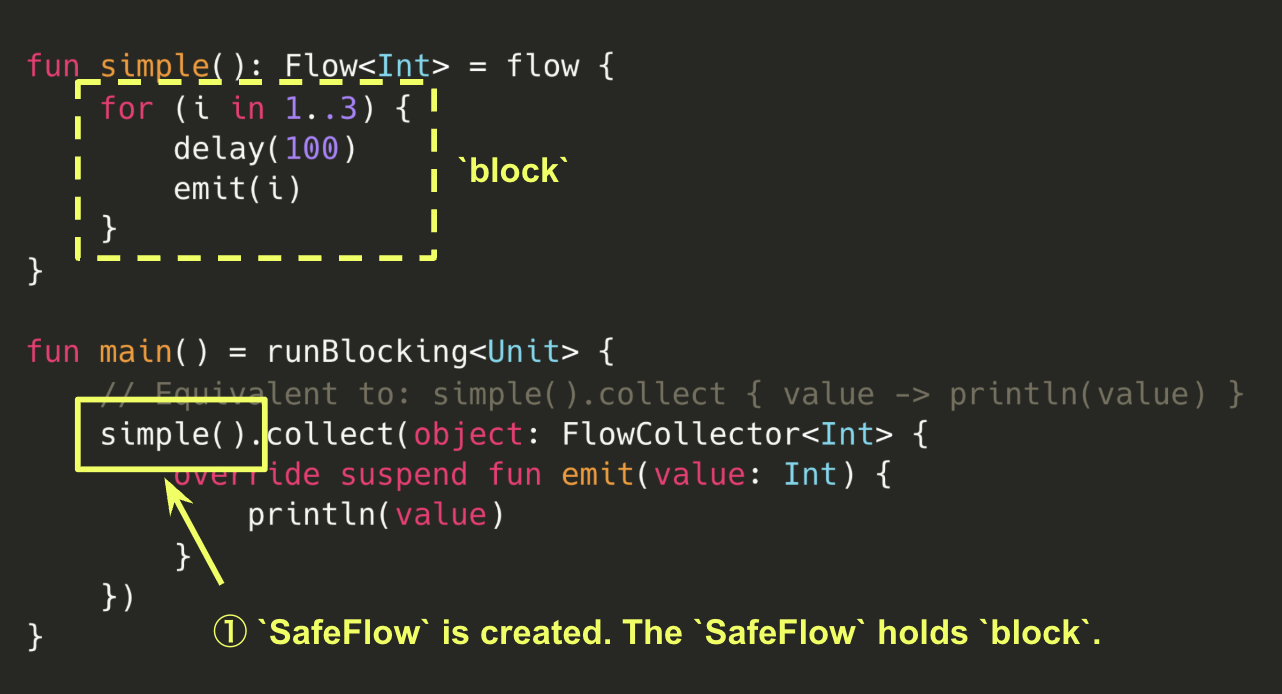
Let’s walk through the sample code step by step. First, the flow function (a Flow Builder) creates a SafeFlow. This SafeFlow holds the lambda (block) passed to flow.
Next, when collect is called, the lambda (block) passed to flow is executed with the FlowCollector passed to collect as its receiver.
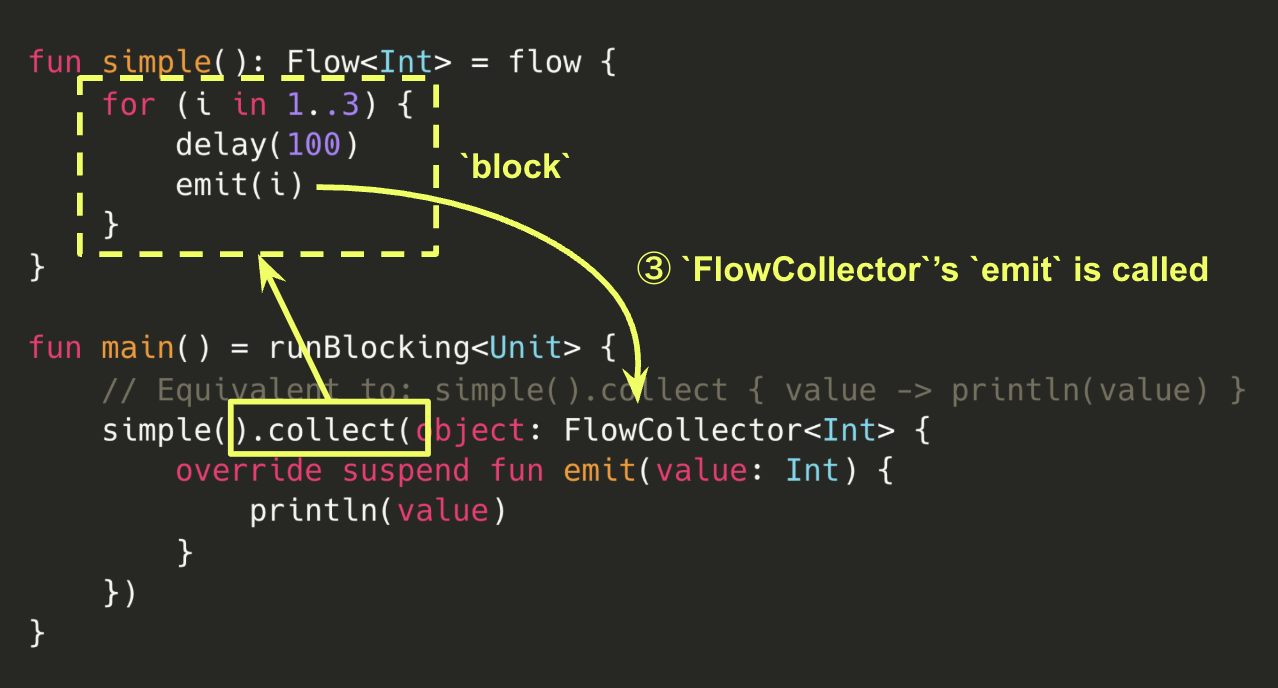
Finally, when emit is called inside flow {}, FlowCollector’s emit is executed — which, when using SAM conversion, is the lambda passed to collect. This confirms our earlier hypothesis.
With this, the relationship and mechanics of the Flow Builder, emit, and collect should now be clear.
The specification that “Cold Flow does not execute until collect is called” can also be explained from this internal implementation: as we can see from AbstractFlow and SafeFlow, it is only when collect is called that the lambda (block) passed to flow is actually executed.
Summary
In this article, we revealed the internal implementation of the three core functions of Kotlin Coroutines Flow: the Flow Builder (flow {}), emit, and collect. Hopefully, you now have a clear mental model of how basic Cold Flow works under the hood.
That said, there is much more to Flow. The following topics will each be covered in separate future articles:
- How Intermediate Flow Operators like
mapwork internally - How Hot Flow works internally
- How context switching with
flowOnworks - How Buffering and Conflation work
- Flow cancellation mechanism
- Flow error handling mechanism
Footnotes
-
Kotlin/kotlinx.coroutines: https://github.com/Kotlin/kotlinx.coroutines ↩ -
Flow sample code in Kotlin docs: https://kotlinlang.org/docs/flow.html#flows ↩
-
Function literals with receiver: https://kotlinlang.org/docs/lambdas.html#function-literals-with-receiver ↩
-
Using builders with builder type inference: https://kotlinlang.org/docs/using-builders-with-builder-inference.html ↩
-
Functional (SAM) interfaces: https://kotlinlang.org/docs/fun-interfaces.html ↩